
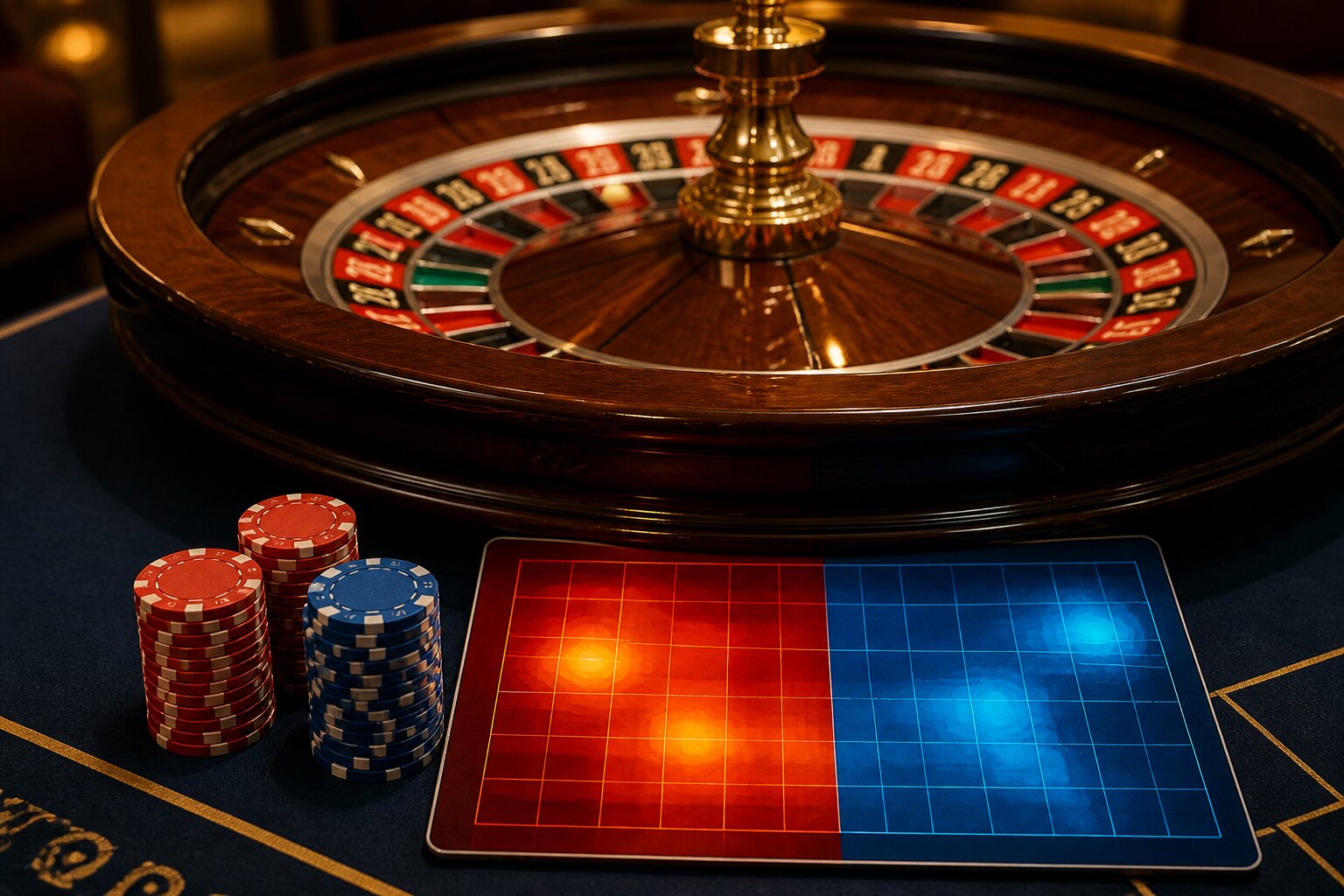
Ever watched a roulette wheel spin and wondered if some numbers just come up more often than others? Perhaps you’ve seen the glossy stats boards flashing ‘hot’ and ‘cold’ numbers at your local casino or on your favourite online site. These lists can be hard to ignore and often pull players into looking for patterns in the game’s recent history.
It’s normal to want a bit more involvement than simply accepting each result as random. Whether you follow the trends closely or treat them with scepticism, hot and cold numbers are a frequent topic at every roulette table and on many game screens.
But what do these labels actually mean, and can they genuinely affect your play? The sections that follow unpack the terms, explain how the figures are produced, and separate common misconceptions from the facts.
What Are Hot & Cold Numbers in Roulette?
Hot and cold numbers are ways of describing how often individual numbers have appeared over a recent stretch of spins. A hot number is one that has shown up more frequently than others within a defined window of play; a cold number is one that has appeared little or not at all in that same window. Casinos and online platforms often display these statistics to show recent results.
These labels do not alter the mathematical odds of any future spin. They are simply summaries of recent outcomes — counts of past events — presented so players can follow trends as the game progresses. This section explains the basic idea; next, we’ll look at why some players pay attention to these trends and what drives that interest.
Why Do Some Players Care About Hot & Cold Numbers?
Players are drawn to hot and cold numbers for several reasons that reach beyond pure mathematics. For many, it enhances the experience by giving them something to watch and discuss. Seeing a number repeat can create a sense of narrative during a session, and groups of players often enjoy debating whether to back a frequent number or try a seldom-seen one.
Psychological factors also play a role. People tend to see patterns even in random data, and that tendency can be reinforced at the table. Social interaction is another factor: friends or other players may encourage bets on numbers that look notable on the stats board, turning the game into a shared activity.
There is no reliable strategy in following hot or cold numbers; they are part of the game’s texture rather than a method for improving outcomes. With that in mind, the next section explains precisely how these figures are calculated so you can understand what the displays are actually showing.
How Are Hot & Cold Numbers Determined?
Hot and cold lists are produced by counting how often each number appears within a chosen span of recent spins. Modern systems automate this: each result is recorded and the totals for a rolling window — often the last 20, 50 or 100 spins — are updated in real time. The numbers with the highest counts are shown as hot; those with the lowest counts, or none at all, are shown as cold.
Different venues and platforms choose different window sizes, which affects which numbers appear hot or cold. A number might be hot over 20 spins but not over 100, simply because short-term sequences can vary. The displays present raw frequencies, not predictions, and are intended as informative or entertaining snapshots of recent play.
Understanding how the data are compiled helps to spot why certain patterns emerge, and prepares you to recognise common misunderstandings about what those patterns mean — which is the focus of the next section.
The Most Common Myths About Hot & Cold Numbers
Misconceptions about hot and cold numbers can lead to false confidence in particular betting choices. One persistent error is the gambler’s fallacy, the belief that a number that has not appeared for a while is somehow more likely to appear soon. In reality, independent from previous spins, each spin’s outcome is independent from previous spins, so prior sequences do not change the probability for any single number on the next spin.
Another myth is that a hot number is “on a roll” in any causal sense, and that backing it yields an advantage. Frequent appearance over a short sample is just a statistical fluctuation and not evidence of a recurring cause. Similarly, seeing one number appear repeatedly does not indicate that the wheel or system is favouring that number.
These misunderstandings can influence betting behaviour, so it’s useful to look at a related question: could the wheel or the technology behind the game actually be creating these patterns? The next subsection examines whether observed streaks might signal a physical or technical bias.
Are Hot & Cold Numbers Proof That Roulette Wheels Are Biased?
The idea that a number’s repeated appearance proves a wheel is biased is unlikely in modern, regulated settings. Physical wheels are subject to maintenance and inspection, and electronic systems are tested to ensure fair operation. Short-term streaks are a normal outcome of random processes rather than a sign of systematic bias.
If a genuine mechanical bias were to occur, operators and regulators would investigate and rectify it, because persistent, verifiable bias is rare and would be noticed quickly. For most players, hot and cold streaks are routine statistical behaviour rather than evidence of a fault.
Does Tracking Hot & Cold Numbers Improve Your Chances?
Tracking hot or cold numbers does not improve the underlying probability of any individual bet. Frequency statistics tell you what has happened, not what will happen. Bets based on past appearance do not change the house edge or the expected return of the game. Using these lists for variety or extra interest is fine, but they should not be relied on as a method for gaining an edge.
Now that we’ve covered myths and bias, it helps to understand the technical safeguards that make modern roulette outcomes random and verifiable — and why those safeguards make hot and cold displays what they are.
Can Casino Technology Affect Hot & Cold Numbers?
Both physical wheels and digital systems are subject to controls designed to preserve fairness. Online roulette relies on random number generator software that is independently tested and certified to produce unpredictable outcomes. Physical wheels are maintained to prevent wear from producing consistent deviations in results.
The hot and cold displays simply reflect recorded outcomes; they do not imply influence by the operator. Regular audits and technical checks mean that the figures shown are a faithful account of recent spins, not an engineered pattern. This context explains why treating those statistics as entertainment rather than instruction is sensible, and it leads naturally into deciding how, if at all, to use them when placing bets.
Should You Use Hot & Cold Numbers When Playing Roulette?
Hot and cold numbers are best regarded as optional extras that can make play more engaging. Some players prefer to follow them for variety or to guide occasional bets; others ignore them entirely. Either approach is reasonable so long as the stakes remain within a predetermined budget and the betting choices do not escalate in response to short-term sequences.
If a player chooses to include hot or cold numbers in their play, doing so in moderation keeps the focus on enjoyment rather than on trying to secure wins. Setting clear limits and treating bets as part of the entertainment prevents decisions being driven by momentary patterns on a screen or board.
Use the statistics as a conversation starter or a way to vary wagers, not as a system to rely on. That balance preserves the social and entertaining elements of roulette while recognising the true nature of the game’s outcomes.
Explore Casino Games at Cash Casino
We’d love to welcome you to our community, where you can enjoy the excitement of casino games in a welcoming and secure setting. Discover a world of entertainment at your own pace with us.
Getting set up is straightforward: simply create an account, make a deposit and you can start exploring a wide range of games. We look forward to seeing you at the tables.
**The information provided in this blog is intended for educational purposes and should not be construed as betting advice or a guarantee of success. Always gamble responsibly.