
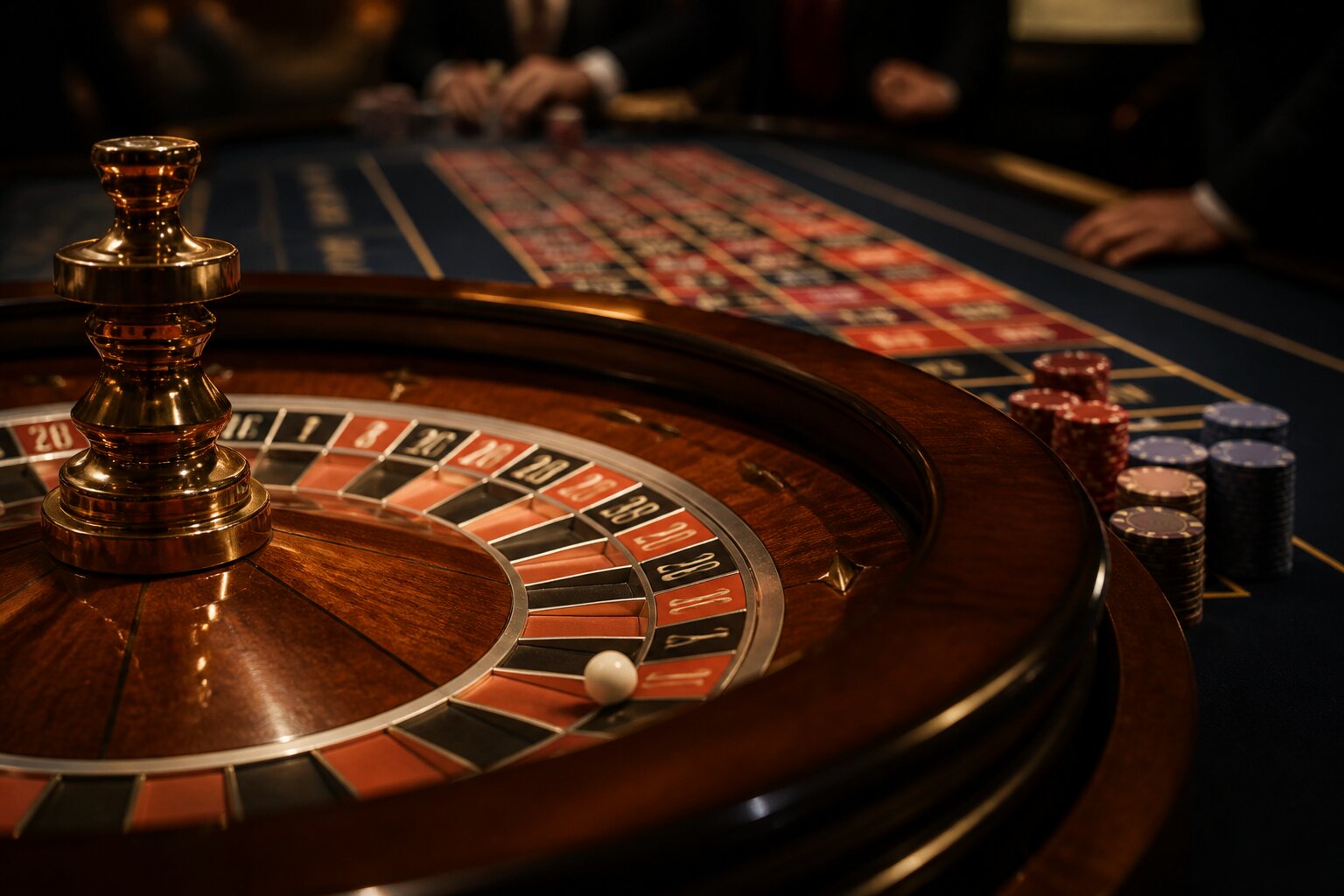
If you’ve watched a roulette wheel for more than a few spins, it’s natural to wonder whether certain numbers return more often than others. Players often search for patterns or streaks, trying to make sense of the sequence of results.
This article looks at the real probabilities behind repeating numbers, what influences those outcomes, and what casino data and simulations tell us. Read on to separate common misconceptions from the mathematics and see what repeat results really mean for players.
What Are The Odds Of The Same Roulette Number Repeating?
Each spin of a roulette wheel is an independent event: one spin’s outcome does not change the next. On a European wheel there are 37 pockets (1–36 plus a single zero), so the probability of any specific number on a single spin is 1/37. On an American wheel there are 38 pockets (adding a double zero), so a single-number chance is 1/38.
To find the likelihood of the same number appearing on consecutive spins, you multiply the single-spin probability for each spin involved. For example, the probability of the same number twice in a row on a European wheel is 1/37 × 1/37 = 1/1,369, which is about 0.073%. On an American wheel the equivalent is 1/38 × 1/38 = 1/1,444.
These calculations reflect basic probability and explain why exact repeats on consecutive spins are uncommon, though not impossible.
What Are The Chances Of Consecutive Number Repeats?
Extending the same multiplication principle shows how rapidly the probability falls as you add spins. For three consecutive occurrences of the same number the chances are:
- European wheel: 1/37^3, which is 1/50,653.
- American wheel: 1/38^3, which is 1/54,872.
Each extra repetition multiplies the improbability, so the mathematics makes it clear that the likelihood drops off very fast. Short runs of repeats will happen from time to time because randomness can produce clusters, but very long streaks are highly unlikely in practice.
It is important to remember that each spin is an independent event governed by fixed probabilities, so past results do not change the odds of future spins. Rather than assuming a system can exploit runs of repeats, it is more realistic to view them as natural outcomes of independent trials and to avoid over-interpreting their significance.
Do Certain Numbers Repeat More Frequently Than Others In Roulette?
It may appear that some numbers recur more often, but under normal circumstances every pocket is intended to have the same chance. Modern, well-maintained roulette wheels are designed and checked so there’s no systematic bias toward particular numbers.
Human perception plays a big part here: we notice occasions when a number appears several times in a short window, and our brains treat that pattern as meaningful. That impression doesn’t mean the wheel is biased; it just reflects how we interpret random sequences.
If a wheel were to develop a mechanical flaw, certain pockets could show a higher frequency, but regulated venues inspect and service equipment to prevent that happening. In practice, persistent overrepresentation of specific numbers is rare and would be investigated by operators.
Analysing Randomness Versus Pattern Perception In Roulette
The tendency to see patterns in random data is well documented. Short-term clusters of repeated numbers are typical in any random process. Independent analyses and statistical tests applied to roulette results can distinguish ordinary variation from genuine bias.
Where data are large enough, the frequencies of individual numbers will converge toward the expected values given by probability theory. Observed deviations over a limited sample size do not indicate a predictable pattern that can be exploited.
This distinction between perceived pattern and statistical expectation is central when interpreting what repeats mean in practice.
How Are Repeating Numbers Calculated In European And American Roulette?
The key difference between the two wheel types is the number of pockets, which directly changes single-spin probabilities. On a European wheel the single-spin chance for a specific number is 1/37; on an American wheel it is 1/38. Each spin is independent, so the outcome of one spin does not affect the next.
For multiple-repeat probabilities, you raise that single-spin probability to the power of the number of consecutive spins you are considering. In formula form, for n consecutive repeats use (1/37)^n for European roulette or (1/38)^n for American roulette. That calculation gives the exact probability of the same exact number appearing n times in a row.
To make this concrete, two exact repeats on a European wheel have probability (1/37)^2, which is about 1 in 1,369. Three repeats are (1/37)^3, roughly 1 in 50,653. The corresponding American figures are slightly lower in probability because of the extra pocket: (1/38)^2 for two repeats and (1/38)^3 for three repeats.
Those simple power calculations are enough to predict how rare longer runs become, and they also show why the additional 00 pocket in American roulette makes exact repeats marginally less likely. The difference is small for short runs but becomes more noticeable as the number of consecutive repeats increases.
What Influences The Repetition Of Roulette Numbers?
Apart from the mathematical independence of spins, the physical condition and design of the equipment are the only practical factors that might affect repetition frequencies. Wheel speed, ball speed and the geometry of pockets all interact in play, but professional venues set strict tolerances and maintain equipment to avoid any consistent bias.
Longevity or damage to a wheel can introduce very small systematic effects, yet regular inspection, calibration and replacement keep those risks low. Where operators find anomalies, they typically remove the wheel for maintenance and review historical results to ensure fairness.
No observation or strategy based on past spins changes the underlying probabilities; equipment condition is the only real-world element that could skew frequencies, and it is controlled in reliable operations.
Are Repeating Patterns In Roulette Wheels A Myth?
Claims that past results can reliably predict future outcomes are not borne out by probability or by empirical testing. Short sequences that look like patterns are natural in random data and do not provide predictive power.
When players talk about “hot” or “cold” numbers they are describing short-term observations rather than a statistical truth. Long-term frequency distributions align with the expected probabilities, and responsible operators monitor results to ensure there is no systematic deviation.
If you see a streak at the table, it is an interesting occurrence to note, but it does not translate into an ability to foretell the next spins.
What Do Real Casino Data And Simulations Reveal About Number Repetitions?
Large-scale analyses—both of recorded casino spin data and of computer simulations using random number generators—show that repetitions and short runs occur at rates consistent with chance. Over many thousands or millions of spins, each number tends to appear in proportion to its theoretical probability.
Simulations are particularly useful because they let researchers model millions of independent spins quickly and check the distribution of repeats, streaks and gaps between occurrences. Those simulated distributions match observations from well-managed casino wheels, supporting the conclusion that the game behaves as a random process with predictable statistical properties.
When small deviations appear in smaller samples, statistical tests can assess whether they are within expected variance or significant enough to warrant further investigation.
Summary: Understanding Roulette Number Repeats And What It Means For Players
Repeating numbers in roulette are a product of independent probabilities and real-world equipment upkeep. Short-term clusters will happen; long runs are mathematically unlikely. No observation of past spins changes the odds for future spins, and data from casinos and simulations confirm that repeats occur as probability predicts.
Enjoy roulette as a form of entertainment, keep wagers within limits you are comfortable with, and treat any perceived pattern as an interesting coincidence rather than a predictable signal. If play ever stops being enjoyable or you feel compelled to chase outcomes, consider taking a break or seeking support. Every spin starts fresh, governed by the same probabilities as the last.
**The information provided in this blog is intended for educational purposes and should not be construed as betting advice or a guarantee of success. Always gamble responsibly.