
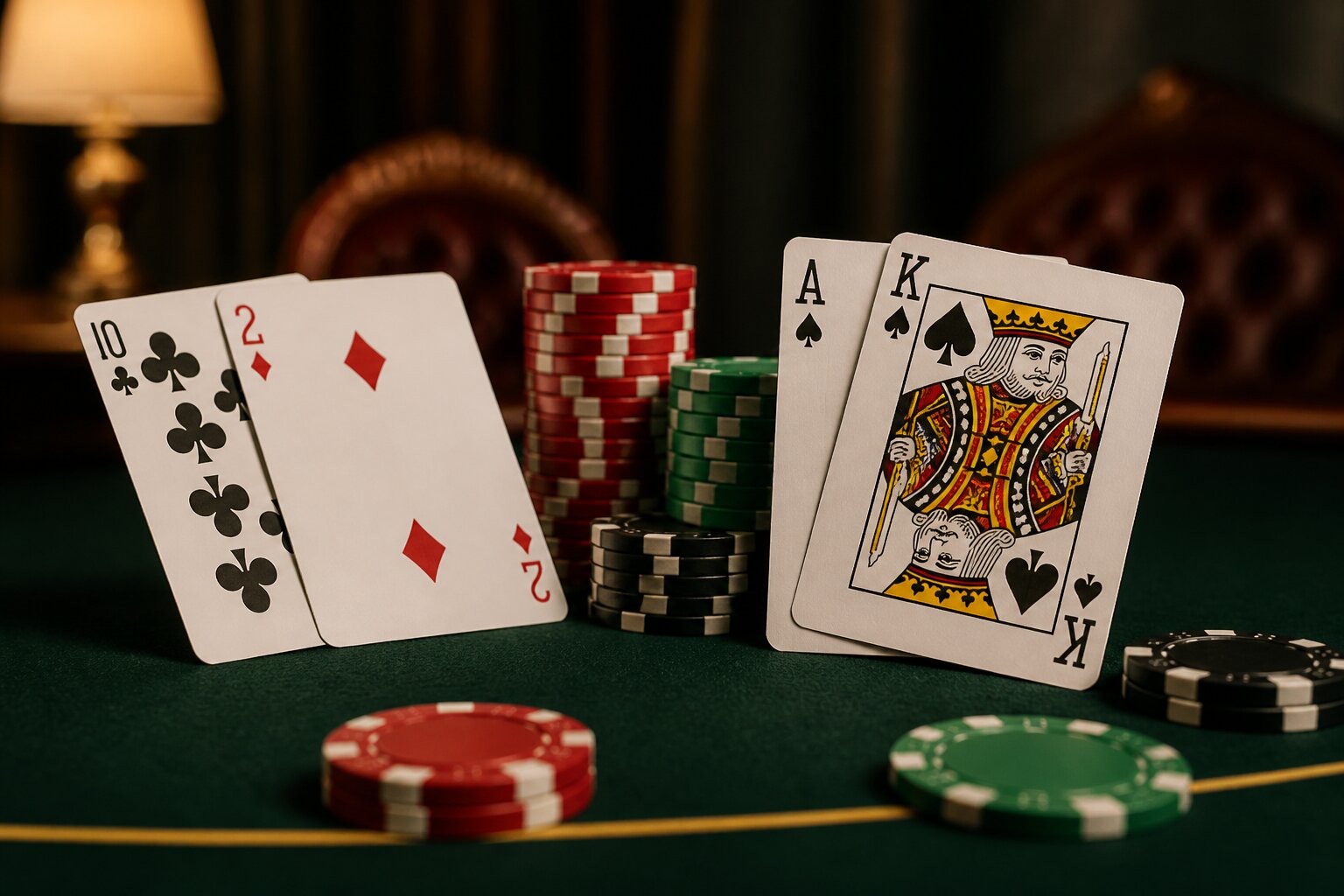
Ever wondered which hands put you in the strongest position at the blackjack table—and which ones make decisions difficult? Knowing how hands rank helps you choose sensible options and stay in control of your play.
This guide walks through how blackjack hand strength is assessed, which starting hands are most favourable and which cause the most trouble, and how the dealer’s card can change everything. Read on to sharpen your understanding so you spot the best moves when the cards are dealt.
Understanding Blackjack Hand Rankings
Blackjack hand rankings are not about named combinations like in poker; they’re about totals. The objective is to reach 21 or as close to 21 as possible without exceeding it. The top outcome is an Ace paired with a 10-value card—called a blackjack—which commonly pays 3:2 and beats ordinary 21s.
Card values are straightforward: Aces count as 1 or 11, face cards count as 10, and numbered cards are worth their face value. That means a 10 and a 7 equals 17, two eights equals 16, and a King and Queen equal 20. Because an Ace can be either 1 or 11, hands containing an Ace are labelled “soft” and have more flexibility than “hard” hands, which have no Ace valued as 11.
A hand’s strength depends on its total and the dealer’s visible card. Strategy and an understanding of probability shape good decisions, and variance in outcomes means no single hand guarantees victory every time. With that framework in mind, the next section explains what makes a hand genuinely good or poor in play.
What Makes a Hand ‘Good’ or ‘Bad’ in Blackjack?
A good hand is one that gives a high probability of winning while allowing manageable decisions on subsequent actions. Totals of 21 are best, with 20 and 19 also offering strong defensive positions. Soft hands—such as Ace-7 called “soft 18”—are inherently valuable because the Ace’s dual value reduces the risk of busting on a hit.
Hard hands carry more risk because any additional card could put the total over 21. Hard 16 is particularly awkward: it’s high enough that hitting often causes a bust, yet low enough that the dealer frequently outscores it. Hands like hard 12 or 13 are similarly uncomfortable when the dealer’s upcard is strong.
The dealer’s upcard alters how good or bad a hand looks. A soft 18 plays differently depending on whether the dealer shows a weak card or a strong one, and a hard 12 can be acceptable against a dealer 4 but dangerous versus a 10. Sensible bankroll management and pre-set betting limits keep play controlled when facing uncertain outcomes, helping decisions stay disciplined rather than emotional.
Examples of the Strongest Blackjack Hands
The strongest starting hands either deliver a high total immediately or offer tactical choices that improve expected outcomes over time. These hands reduce the number of decisions you need to make and often put pressure on the dealer. The most notable examples follow.
Blackjack: The Unbeatable Hand
An Ace plus a 10-value card creates blackjack, the strongest result on a single hand and typically paid at 3:2. This hand beats all ordinary 21s and places the player in the most secure position possible at the table. If the dealer also has blackjack, the round is a push and wagers are returned.
Payouts can vary by casino, with some venues offering different rates such as 6:5; this change reduces the player advantage, so it is worth being aware of the house rules where you play. Blackjack also generally removes the need to act further on that hand, though options such as insurance or side bets may still be offered depending on the game.
Hands Worth 20: Reliable Winners
A total of 20, most often two 10-value cards, sits one point shy of 21 and is one of the most comfortable hands to stand on. It is a hard total that rarely improves with a hit, so standing and forcing the dealer to act is usually the best option. Against many dealer upcards this total has strong expected value and will win more often than it will lose.
Players sometimes consider splitting two tens, but that is a strategic choice that typically weakens a strong standing hand. The choice to split or not should reflect the rules of the table and the dealer's upcard, as well as the player’s tolerance for risk in the short term.
Double Aces: The Potential for Splitting
Two Aces count as 12 when combined, but their real value is strategic rather than numerical. Splitting Aces creates two hands that each start with an Ace, giving two separate chances to reach high totals including 21. Because splitting requires an additional wager, the decision to split hinges on both table rules and the dealer’s upcard.
Many casinos limit split Aces to receiving only one additional card on each Ace, so the potential benefit must be weighed against that restriction. Splitting is generally a powerful move when permitted, but its effectiveness depends on the specific rules in play and on how many decks are used at the table.
These hands illustrate two ways strength manifests: immediate high totals and options that improve future probabilities. They show how both outright value and flexibility can work in a player’s favour within the structure of the game. Next, we’ll turn to the hands that cause the most headaches.
What Are the Weakest Possible Blackjack Hands?
Some starting totals consistently leave players with difficult choices and unfavourable odds. These hands are not hopeless, but they demand careful consideration because their expected outcomes are lower than many alternatives. Playing them well depends on understanding the likely dealer ranges and following a disciplined approach to stakes and strategy.
16 Against the Dealer’s Face Card
Hard 16 is widely regarded as the most uncomfortable total, especially versus a dealer’s 10-value upcard. With a 10 showing, the dealer is positioned to reach totals that beat a standing 16, yet hitting from 16 risks busting. This dilemma makes the hand a frequent source of tension at the table.
The decision often comes down to whether to take another card or to minimise losses by surrendering where the rules allow. Many players will choose to hit if surrender is not available, but that choice still carries a high chance of breaking the hand. Keeping bets conservative on these hands and knowing the table rules can reduce the long-term impact of repeatedly facing 16.
15: A Risky Position
A total of 15 has similar problems: it is too low to be safe but high enough that drawing carries a substantial bust risk. When the dealer shows a strong upcard, the challenge intensifies because even modest dealer totals will often beat 15. The balance between aggression and caution is narrower here than with many other totals.
Players who accept that 15 is a marginal hand will often adjust their play according to the dealer’s visible card and the surrounding betting. If the dealer’s upcard is weak, standing may be more sensible; against strong upcards, some players prefer to hit or surrender when allowed. Again, keeping bets within sensible limits helps manage the variance these hands introduce.
Low-Value Starting Hands
Totals of 12 to 14 offer little room. They often force a choice between a hit that could bust and standing on a total unlikely to prevail. These hands lack flexibility and require careful attention to the dealer’s visible card to choose the best approach.
Against dealer upcards that are likely to break or make weak totals, standing can be the wiser option, whereas stronger upcards usually call for a hit. The margins are small, so consistent strategy and disciplined bankroll management are important when these hands appear frequently.
Although these hands are statistically weaker, decisive play and consistent betting limits keep them manageable within a broader strategy. Understanding how the dealer’s upcard reshapes these positions is essential, and that effect is the subject of the next section.
How Dealer Upcards Impact Hand Rankings
The dealer’s upcard is a primary factor in judging whether to hit, stand, or split. A weak upcard—commonly 4, 5, or 6—raises the chance the dealer must hit into a total that busts, which makes standing on marginal totals more attractive. Against these upcards, hands such as 12–16 improve in relative strength because the dealer faces a higher probability of failure.
Conversely, a dealer showing a 10 or an Ace increases the likelihood the dealer will reach a competitive total, so the same player hands become more vulnerable and require more aggressive options. This shifting balance is why basic strategy charts vary decisions by comparing your total directly with the dealer’s visible card rather than ranking hands in isolation.
Appreciating how the dealer’s card changes the odds helps refine decisions for both strong and weak hands, and it leads naturally to another common question about the game: whether suits or the order of cards have any bearing on outcomes.
Do Suits or Card Order Matter in Blackjack?
Suits and the sequence cards were dealt have no effect on hand value or strength in blackjack. The game reduces each hand to a numerical total: an Ace plus a 10-value card equals 21 regardless of suits or whether the Ace came first or second.
This simplicity keeps focus on totals and strategic choices rather than irrelevant details, which makes blackjack easier to learn and analyse. With that clarity, players can direct attention to reading the dealer’s upcard, recognising soft versus hard hands, and applying probability-informed decisions—factors that truly influence results at the table.
When you combine an understanding of totals, the role of soft hands, and how the dealer’s upcard shifts odds, you have a clear framework for evaluating any hand you’re dealt. Playing within a budget and following consistent strategy ensures the experience stays measured and enjoyable.
Play Online Casino Games at Cash Casino
We invite you to enjoy the welcoming atmosphere of our site whenever you fancy a game. Take your time, settle in, and explore everything we have to offer at your own pace.
Getting started is straightforward – simply create an account, make a deposit, and you're ready to play. We look forward to welcoming you to the Cash Casino community.
**The information provided in this blog is intended for educational purposes and should not be construed as betting advice or a guarantee of success. Always gamble responsibly.