
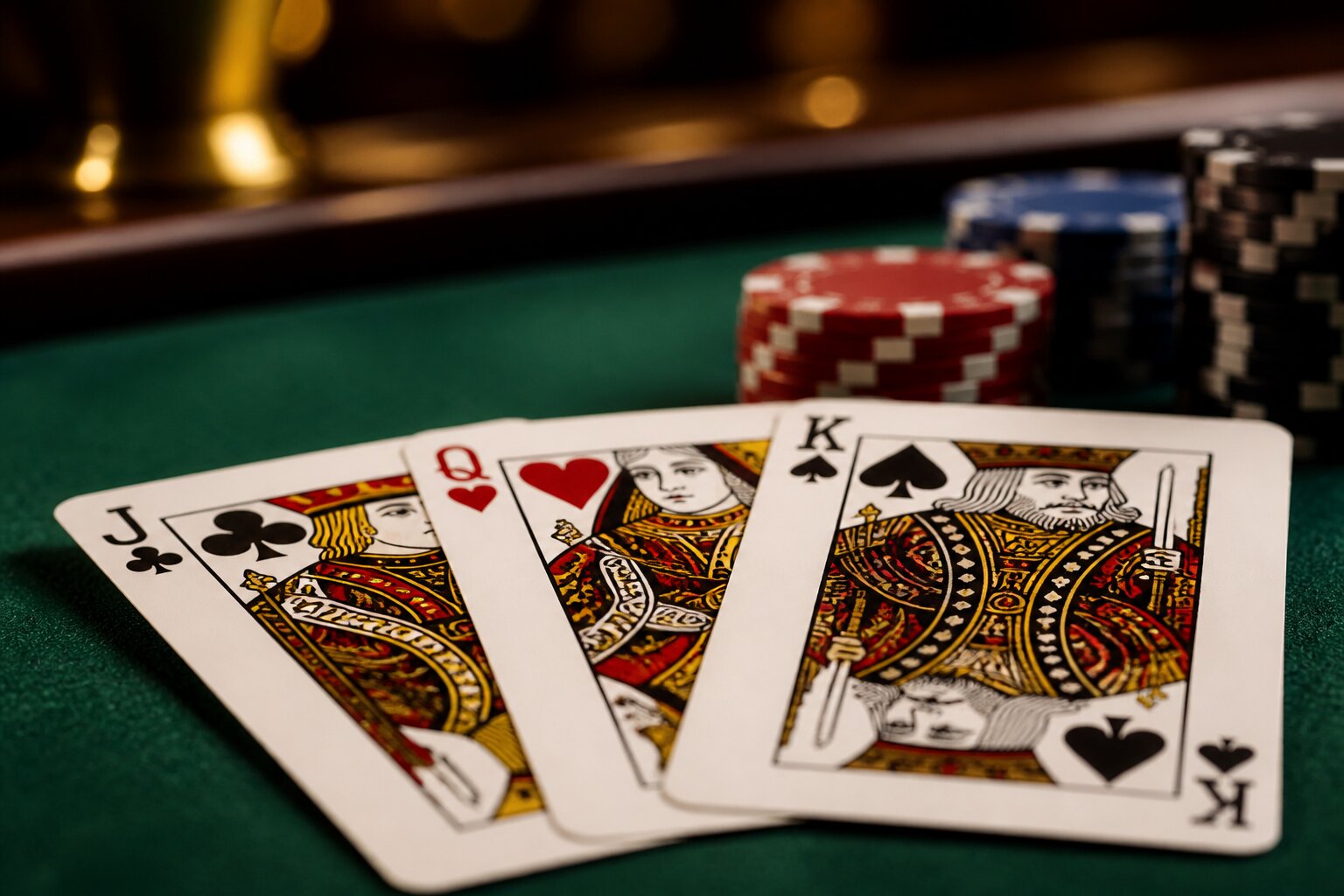
If you’ve ever sat down at a blackjack table, you’ll know the sight of a king, queen or jack catching your eye. Those cards are simple to spot, but what they mean for your hand is worth understanding.
This guide explains card values in blackjack, focusing on face cards and how they fit into the rest of the deck. Whether you’re new to the game or refreshing your knowledge, the aim here is to make the rules clear and easy to follow.
Ready to see how face cards shape your strategy and totals? Let’s get started.
What Are Face Cards in a Deck of Cards?
Face cards are the king, queen and jack in each suit. With four suits in a standard deck—hearts, diamonds, clubs and spades—that gives you 12 face cards in a 52-card deck.
They’re easy to identify because they carry portrait artwork instead of a numbered value, marked by letters (K, Q, J) and the suit symbol. In card games such as blackjack, they’re grouped together because they share the same point value, which makes it quicker to add up a hand when you see them.
Recognising these cards fast helps speed decision-making at the table and reduces small arithmetic errors when you’re totalling your hand.
How Much Are Face Cards Worth in Blackjack?
In blackjack, each face card is valued at 10 points. That applies to every face card regardless of suit, so their contribution to your total is always the same.
The face cards are:
- King — 10 points
- Queen — 10 points
- Jack — 10 points
This fixed value makes face cards particularly useful when you want to approach 21 without busting. For example, two face cards together make a total of 20, a strong hand value in many situations. Their consistency also simplifies the arithmetic compared with cards whose value can change, such as aces.
If you spot a face card with an ace, you will often recognise the special combination it creates: an ace plus any 10-point card is a natural blackjack. More on that next.
Understanding the Value of Other Cards in Blackjack
To see where face cards fit, it helps to look at the rest of the deck. Number cards from 2 to 10 are worth their printed value: a 7 is seven points, a 3 is three points, and so on. Aces are flexible and can count as either 1 or 11, chosen to give the best total for the hand.
Jokers are not part of the game and are ignored if present in a physical deck.
Putting these values together is how hand totals are formed. For example, a face card plus an ace can be scored as 21 (10 + 11), while two number cards and an ace might be adjusted so the ace counts as 1 instead of 11 to avoid going over 21.
Why Are Face Cards Important in Blackjack?
Face cards matter because their 10-point value makes them powerful building blocks toward strong totals. One of the reasons they feel significant is that when paired with an ace they produce a natural 21—commonly called a “blackjack”—which usually beats most other hands and often pays a bonus.
Beyond blackjack hands, face cards help players reach totals like 20 quickly, which is a hand many players choose to stand on. Their uniform value also reduces calculation complexity: you don’t need to check suits or special rules to know a face card’s contribution.
If you’re watching how a hand develops, seeing face cards early gives a clear picture of how flexible the remaining cards will need to be.
Does the Value of Face Cards Change in Different Versions of Blackjack?
Across most blackjack variants, face cards keep their 10-point value. Whether the game uses a single deck or multiple decks, or whether you’re playing European or American-style rules, the face card value is a constant.
What does vary between versions are other rules: how many decks are used, whether the dealer hits or stands on soft 17, doubling and splitting options, and payout rates for a natural blackjack. Those rule differences can affect strategy, but they don’t change what a face card is worth.
If you try a new table or online game, it’s sensible to check the house rules for things like payouts and doubling, but you can rely on face cards to remain at 10 points.
Are There Myths About Face Cards in Blackjack?
Players often develop beliefs about patterns in the cards—suggestions that certain seats, times of day, or rituals influence when face cards appear. In practice, each dealing is independent of previous hands, and no approach will alter the dealing order.
Some players talk about “hot” or “cold” streaks, but these ideas describe perception rather than a rule that affects play. The useful takeaway is that strategy should respond to the visible cards and table rules rather than to expectations about future deals.
If you find superstitions creeping into your decisions, it can help to focus on the concrete aspects you can control: the current hand total, the dealer’s visible card and the specific rules of the game you’re playing.
Summary of Blackjack Card Values
A clear understanding of card values makes it easier to follow and enjoy blackjack. Here’s a concise recap of how cards are scored:
Card Values at a Glance
- Face cards—kings, queens and jacks—are worth 10 points each.
- Number cards (2 to 10) are worth their face value.
- Aces can count as either 1 or 11, depending on which benefits the hand.
- Jokers are not used in blackjack.
These values are standard across most versions of the game, though individual tables may differ on other rules. Read the table rules where you play so you know how hands are settled and what payouts apply.
If you’re new to the game or brushing up, these basics will make it easier to follow play and make decisions confidently. Remember to play only if you’re 18 or over and keep entertainment as your main aim. If you’re ever concerned about your gambling, help and advice are available.
**The information provided in this blog is intended for educational purposes and should not be construed as betting advice or a guarantee of success. Always gamble responsibly.