
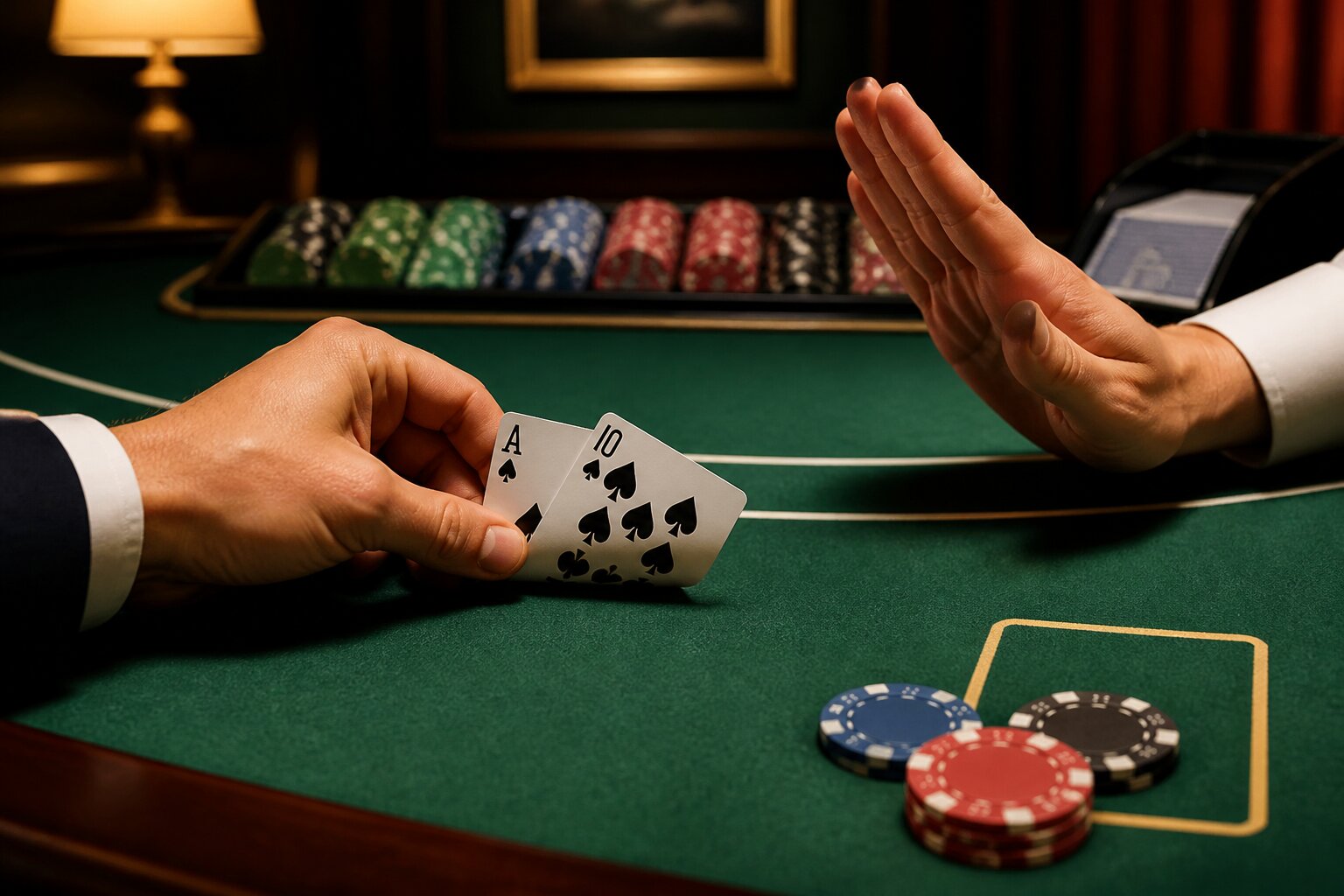
Ever been stuck at the blackjack table, unsure whether to take another card or stick with what you have? You are not alone, this is the key decision every player faces each hand.
Knowing when to hit or stand changes how a hand plays out. With a few clear principles you can make better choices that align with the mathematics of the game and reduce costly mistakes.
Ready to take the guesswork out of your next game of blackjack? Keep reading and you will have a reliable approach to use at the table.
What Does “Hit or Stand” Mean in Blackjack?
In blackjack, hit and stand are the two basic options a player has on their turn. They determine whether you ask for one more card or keep your current total and end your turn.
Choosing to hit means you request another card from the dealer, hoping it improves your total without putting you over 21. Standing means you stop taking cards and let the dealer play against the total you have.
The objective is to achieve a total close to 21 without exceeding it. Your decision should weigh the risk of going over against the chance of improving your total, using what you can see at the table to estimate which option is preferable.
How Do You Decide When to Hit or Stick?
Decisions about hitting or standing rest on basic strategy, a set of mathematically derived guidelines that tell you the statistically best play for every combination of player total and dealer upcard.
Start by assessing your total, and compare it with the dealer’s visible card. Charts based on basic strategy indicate when to hit, stand, split or double down depending on those two pieces of information and the specific table rules. These charts are derived from probabilities, not promises, and aim to minimise the house edge over many hands.
Alongside the chart, consider table rules that can change correct plays, such as whether the dealer hits or stands on soft 17, or whether doubling after a split is allowed. These rule variations alter some strategic choices, so a chart aligned with the game you are playing will be most useful.
Common Scenarios: What Should You Do?
Many hands fall into recurring patterns, and recognising these helps you act quickly and with confidence.
Hands of 12 to 16 are known as stiff hands, because a single high card will bust you. If the dealer shows a 7 or higher, the standard approach is to hit, since the dealer has strong potential to reach a competitive total. Conversely, if the dealer shows a 2 to 6, standing is often recommended because the dealer has a higher chance of busting while trying to reach at least 17.
With totals of 17 or more, standing is usually the safer option because the probability of busting on another card increases substantially. For very low totals, such as 8 or less, hitting is typically correct because one more card cannot make you bust and it improves your winning chances.
These general rules cover many situations, but remember that soft totals (hands containing an ace counted as 11) and pairs change the calculations and may call for different moves.
Understanding Dealer Upcards in Blackjack
The dealer’s upcard provides a vital hint to the likely outcome of the dealer’s hand, and it should shape your approach.
Upcards of 7 through Ace are commonly treated as strong because the dealer can reach a solid total without needing many extra cards. Upcards of 2 through 6 are weaker in the sense that the dealer must draw more cards and faces a higher chance of busting while attempting to reach 17 or more.
By paying attention to the upcard, you adjust your risk tolerance. Against strong upcards you may be forced into hitting more aggressively to reach a competitive total, while against weaker upcards you can take a conservative line and force the dealer to draw.
Most Frequent Player Mistakes to Avoid
Several recurring errors hurt players more than they realise. Spotting and correcting these improves long-term results and keeps play more enjoyable.
Relying on emotion rather than strategy is a common pitfall. Chasing recent losses by increasing stakes or abandoning basic strategy reduces control and raises the chance of bigger losses. Another mistake is failing to learn how specific rule variations affect correct play, which leads to misapplied chart moves.
Overconfidence in short-term outcomes can also be costly. Decisions should be based on the current hand and the dealer’s upcard, not past hands or a sense that a streak will continue. Staying disciplined with bankroll limits and following the strategy appropriate for the game you are playing will help avoid these errors.
Myth-Busting: Is Following Your Gut the Best Approach?
Instincts can feel persuasive, but they do not replace information. Blackjack decisions are best guided by an understanding of probabilities and by following established strategy for the particular rules at your table.
Trusting a hunch tends to produce inconsistent decisions, while a steady strategy produces more predictable results over time. Keep your choices grounded in what the cards and the dealer’s upcard indicate.
How Does a Blackjack Chart Help?
A blackjack chart is a compact reference mapping player hands against dealer upcards, recommending the statistically preferred action for each situation.
Using a chart removes guesswork. Match your hand and the dealer’s upcard to the chart and it suggests whether to hit, stand, split, or double down, taking into account common rule variations if the chart is tailored to your game. It is a practical tool for improving decision quality, particularly for newer players.
Charts do not change the probabilistic nature of outcomes, but they do help you make choices that reduce the house edge when followed consistently. Treat the chart as a guide for sound decisions rather than a guarantee of a particular result.
Essential Tips for UK Blackjack Players
Set a clear budget before you play and keep your sessions short to maintain focus. Breaks help you think more clearly and stick to planned limits.
Use account tools offered by reputable operators to control deposits and session length. These features support consistent, controlled play and make it easier to stick to the rules you set for yourself.
Play at operators regulated by the UK Gambling Commission to ensure consumer protections and fair play standards. If play stops being enjoyable, seek support from UK-based organisations that offer confidential advice and practical tools for managing play.
Above all, keep your play within the boundaries you set and accept that outcomes are uncertain; sensible limits and measured decisions are the best way to preserve enjoyment.
When Should You Never Hit or Stand?
There are moments when neither a hit nor a stand is the optimal move because additional options change the calculus.
Actions such as splitting or doubling down can convert a marginal situation into a stronger one, depending on the hand and the dealer’s upcard. Recognising when these alternatives offer a better expected outcome is part of sound play.
Splitting and Doubling Down
Splitting converts a pair into two separate hands, which is often correct when a pair of eights or aces is dealt, because it improves the chance of reaching competitive totals on each hand. The decision to split depends on both the pair and the dealer’s upcard.
Doubling down increases your stake for one additional card and is commonly used when your initial total is 10 or 11 and the dealer shows a weaker card. This move aims to capitalise on a favourable situation when the odds of improving to a strong total are higher.
Know Your Choices
Understanding all available options keeps you flexible. The rules at your table determine which moves are permitted and how advantageous they will be. Observing how those rules interact with the dealer’s upcard and your own hand is the best way to make choices that align with basic strategy.
Play thoughtfully, stay aware of alternatives beyond hit and stand, and keep your play within the limits you set. That approach helps you make better decisions and enjoy the game responsibly.
**The information provided in this blog is intended for educational purposes and should not be construed as betting advice or a guarantee of success. Always gamble responsibly.