
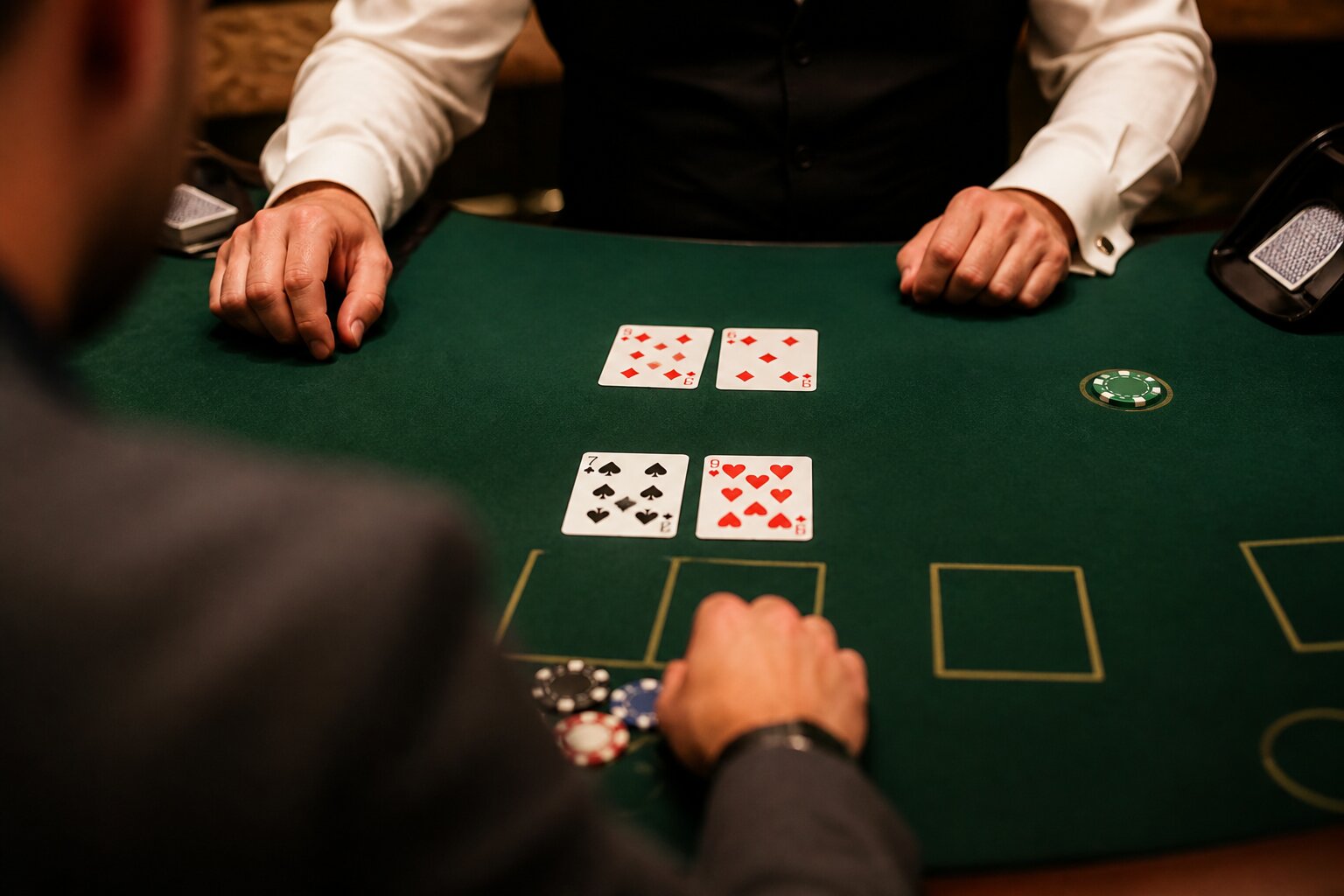
Blackjack is one of the most popular casino games in the UK, but it’s not just about getting 21. There are lots of small rules and results that change how a hand plays out, and a “standoff” is one you’ll want to recognise.
If you’ve ever watched a round end with both the player and dealer showing the same total, that’s a standoff — a situation that affects your stake but not your winnings. Understanding it helps you read the table and know what happens to your bet when a tie occurs.
In this post we’ll explain what a standoff is, when it happens, how casinos handle it and why the distinction between terms matters. Read on to clear up any confusion and get a firmer grasp of how tied hands are resolved.
What Does a Standoff Mean in Blackjack?
A standoff in blackjack is simply a tie between your hand and the dealer’s when play for that round is finished. Casinos commonly call this a “push.” Neither side wins or loses the round; both hands remain active and equal in value.
The practical effect is straightforward: your original wager is returned. You don’t gain a payout, but you also don’t lose the stake you placed. What led to the matching totals — whether by drawing extra cards, standing early, or having the same initial value — doesn’t change the outcome.
Think of a standoff as a neutral result built into the rules of the game. It makes the outcome fair when neither party can claim a higher valid total.
When Does a Standoff Occur in the Game?
A standoff becomes relevant at the end of the dealer’s turn, once all cards have been resolved and any draws completed. It can happen with any matching total — 16, 18, 20 or even 21 — provided neither side has exceeded 21.
How the totals were reached is immaterial; the only requirement is that both hands are still live and end on the same value. If the dealer busts and your hand is under 22, you win outright, so a standoff cannot occur in that scenario. Similarly, if you have surrendered or otherwise forfeited the hand earlier, a tie won’t apply because your stake has already been resolved.
In multi-hand or split situations each individual hand is compared to the dealer’s final total separately, so a single round can produce a mix of wins, losses and standoffs across your hands.
How Are Standoffs Handled by Casinos?
Casinos process a standoff in a transparent, rule-based way: the player’s original stake is returned and the round is recorded as a draw. There is no additional payout and no further penalty applied to the returned amount.
Tables and electronic systems mark the result clearly so you can see the push has occurred. If you want to continue playing, the returned funds are available immediately to place on the next hand; there’s no delay or reclassification of the money. For split hands, each hand’s bet is checked against the dealer’s total independently, so one split hand might push while another wins or loses.
Regulated casinos follow consistent procedures for this outcome to ensure fairness and to avoid disputes about what happened during the round.
Standoff Outcomes: What Happens to Bets?
When a standoff is declared, your bet is neither lost nor increased — it is simply given back to you. The accounting is clear: the casino does not pay a win, and it does not charge a loss; the stake returns to the player’s balance as it was before the hand.
This applies to both cash and electronic play, whether the wager was placed on a single hand or on one of several split hands. If a round involves side bets, insurance or other optional bets, those are usually settled according to their own rules and may not be affected by the main-hand push; check the specific game rules if you use add-on bets.
Because the returned stake is available to bet again immediately, a standoff often feels like a brief pause rather than a conclusive result, which is why recognising it as a distinct outcome is useful when you’re following a series of hands.
Common Misconceptions About Standoffs
There are a few recurring misunderstandings about standoffs. Some players expect an extra chance to play the same hand again automatically, or assume a push triggers a bonus; neither is the case. A standoff is a finished result with no extra cards or rewards attached.
Another myth is that certain moves can force a standoff more often. Strategies change the likelihood of different totals, but they don’t create special push mechanics — the game simply compares final totals according to the rules. Similarly, standoffs are not graded as “good” or “bad” outcomes in themselves; they are a neutral part of the game’s result set.
Clearing up these points helps keep expectations realistic and reduces confusion at the table.
How Do Standoffs Affect Player Decisions?
Knowing that a standoff returns your stake can influence how you view tight situations near the end of a round. It may change the way you mentally weigh the risk of a close hand, since a tie avoids a loss and preserves your bankroll for the next hand.
That said, standoffs are one possible result among many and should not be treated as a strategy target. It’s sensible to plan play around limits and bankroll management, so you’re prepared for wins, losses and pushes alike rather than chasing any single outcome.
If you use optional bets or split hands, factor in how each will be settled independently; that context can affect whether continuing to play a sequence of hands fits your overall approach.
Standoff vs Push: What Is the Difference?
Are Standoff and Push the Same?
In practical terms, “standoff” and “push” describe the same result: a draw where the player’s bet is returned. The two words are interchangeable in most casino settings, and there is no difference in how the hand or the stake is resolved.
Why Are There Two Terms?
Language and local custom account for the different terms. Some dealers and players prefer “push,” others use “standoff,” but both signal the same neutral outcome and follow the same rules.
Understanding both terms removes any confusion when you hear either one during play and lets you focus on the game rather than the vocabulary.
This explanation brings the topic to a close: a standoff is simply a tied hand with the original stake returned, handled consistently by casino rules so you always know how that outcome will be treated.
**The information provided in this blog is intended for educational purposes and should not be construed as betting advice or a guarantee of success. Always gamble responsibly.