
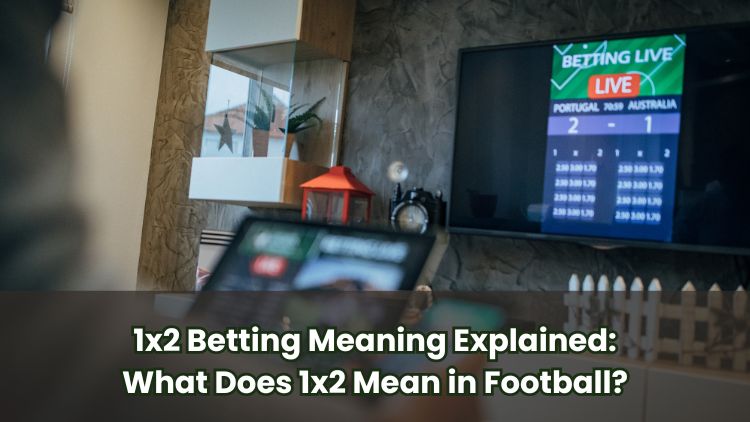
If you are new to football betting, the term “1x2” can look puzzling at first. It appears on most sportsbooks without much context, yet it sits at the heart of how many football markets are framed.
Below, we explain what 1x2 means, how the odds and payouts work, and walk through clear examples for single bets and accumulators so the maths feels straightforward.
We also outline useful variations like Half-Time and Full-Time 1x2, compare the market with Draw No Bet and Double Chance, highlight common mistakes, and finish with a quick glossary. If you choose to bet, keep it affordable and within your limits.
What Does 1x2 Stand For In Football?
In football betting, “1x2” is a simple way of showing the three possible outcomes of a football match.
The “1” stands for a home win, meaning the team playing at their own ground wins the match. The “x” means a draw, where the match ends with both teams on equal goals. The “2” stands for an away win, meaning the visiting team wins the match.
This format usually refers to the result after 90 minutes of normal play, plus injury time, and does not include extra time or penalties unless a market states otherwise.
In short, 1x2 lets you pick which of the three results will be recorded at full time. With that in mind, it helps to know exactly how these bets are settled.
How Does 1x2 Betting Work?
1x2 betting centres on choosing one of three outcomes: home win (1), draw (x), or away win (2). Selections are settled on the official result at full time, which is 90 minutes plus any added time. If a match goes to extra time or penalties, those periods do not apply to the standard 1x2 market.
For example, if someone selects the home team (1) and that team is ahead when the final whistle sounds at the end of normal time, the bet wins. If the match is level, only “x” wins. If the away side leads, “2” is the winning choice.
Once that framework is clear, the next step is reading the odds attached to each outcome.
How To Read 1x2 Odds?
Every 1x2 market displays three prices: one for the home win (1), one for the draw (x), and one for the away win (2). These prices show the potential return if the selection is correct.
Odds may be shown in fractional (e.g., 5/2) or decimal (e.g., 3.50) formats. With fractional odds like 2/1, a winning £1 returns £2 profit plus the £1 stake. With a decimal like 3.00, the figure already includes the stake, so £1 would return £3 in total.
Higher odds indicate a lower expected probability for that outcome, while shorter odds suggest a higher expected probability. Most betting sites display the potential return on the bet slip before you confirm a selection, and many offer calculators if you want to check the numbers.
Understanding the price is one thing; knowing how it translates into a payout is the next.
How Are 1x2 Payouts Calculated?
Payouts depend on the odds and the stake. With fractional odds, profit is stake multiplied by the first number divided by the second, then the stake is added to get the total return. With decimal odds, multiply the stake by the odds to get the total return.
Example: Single Bet Calculation
For a single bet, the payout is based on the odds for the selected outcome and the amount staked.
If a player places £5 on a home win at 2/1 and it wins, the profit is £10 (£5 x 2), plus the original £5 stake, for £15 in total. Using decimal odds of 3.00, the same £5 would return £15 (£5 x 3.00), including the stake.
Example: Accumulator Calculation
An accumulator combines multiple 1x2 selections into one bet, and all must win for a return.
For instance, a £2 accumulator at decimal odds of 2.00, 2.50, and 3.00 would roll over with each result: £2 at 2.00 becomes £4, that £4 at 2.50 becomes £10, and £10 at 3.00 becomes £30. If every selection wins, the payout is £30. Accumulators can raise potential returns, but adding more picks also increases the chance that one selection will fall short.
What Market Variations Exist In 1x2 Betting?
1x2 betting is not limited to the final result alone. The most common variations are Half-Time 1x2 and Full-Time 1x2, which specify the period the result applies to. Always check the market description so the timing is crystal clear.
Half-Time 1x2
The Half-Time 1x2 market settles on the score at the break. Only events in the first half count. If a player expects the home side to be ahead after 45 minutes, “1” is the selection in this market.
Full-Time 1x2
Full-Time 1x2 refers to the result after 90 minutes plus injury time and is the default version most people mean when they say “1x2.” Extra time and penalties are not included unless stated.
Once the time period is understood, it becomes easier to see how 1x2 compares with closely related markets.
How Does 1x2 Differ From Draw No Bet And Double Chance?
While 1x2 presents three separate outcomes, Draw No Bet and Double Chance adjust what is covered.
Draw No Bet removes the draw from the equation. You pick either home or away. If the game finishes level, the stake is returned. Because the draw is effectively insured against, the price offered is usually shorter than the straight 1x2 equivalent.
Double Chance allows coverage of two results in a single selection, typically home or draw, away or draw, or home or away. Covering more outcomes increases the chance of a winning result, so the odds are generally lower than the standard 1x2 prices.
Common Mistakes To Avoid With 1x2 Bets
A frequent slip is forgetting that standard 1x2 settles on 90 minutes plus injury time, as noted earlier. Goals in extra time or penalties will not change the outcome of a Full-Time 1x2 bet.
Team news can have a strong impact. Ignoring injuries, suspensions, or a rotated line-up may lead to a pick that no longer matches the shape of the match.
Letting opinion outweigh evidence is another pitfall. Backing a favourite club or following crowd sentiment without considering recent form, head-to-heads, or underlying numbers can leave gaps in reasoning.
Overlooking the draw is also common. Many fixtures finish level, so “x” is often a realistic selection rather than an afterthought.
Chasing losses can quickly escalate costs; setting limits in advance helps keep control.
When Is 1x2 The Right Market To Choose?
1x2 suits anyone who prefers a clear, simple view of a match: home win, draw, or away win. It is a good fit when the interest is in the result at full time rather than extra time scenarios.
It can be useful when analysis points towards a strong view on the outcome after looking at squad news, form, tactics, or schedule. If a player wants a more cautious approach, related markets such as Double Chance or Draw No Bet provide extra cover, but at shorter prices.
Pick the market that matches how confident you feel about the match picture. If any terms are unfamiliar, the quick glossary below will help.
Key Terms To Know In 1x2 Betting
Understanding a few common terms can help make 1x2 betting clearer for everyone:
- 1 – Refers to a home team win in the match.
- x – Indicates a draw, meaning both teams finish with the same number of goals after 90 minutes.
- 2 – Stands for an away team win in the match.
- Full-Time Result – The outcome of the match after normal time (90 minutes plus injury time).
- Half-Time Result – The score at the end of the first half only.
- Accumulator (Acca) – A bet that combines several selections. All choices must be correct for the bet to win.
- Decimal Odds – A way of showing odds that includes the stake in the total return (e.g., odds of 2.50 mean £1 returns £2.50).
- Fractional Odds – Traditional odds format in the UK (e.g., 5/2), where the first number shows the profit relative to the second number wagered.
- Stake – The amount of money placed on a bet.
If you choose to bet, keep it affordable, set limits that suit your situation, and take regular breaks. If gambling starts to affect your well-being or finances, seek support from independent organisations such as GamCare and GambleAware. With the essentials and terminology in place, 1x2 should feel clear and manageable from here.
**The information provided in this blog is intended for educational purposes and should not be construed as betting advice or a guarantee of success. Always gamble responsibly.