
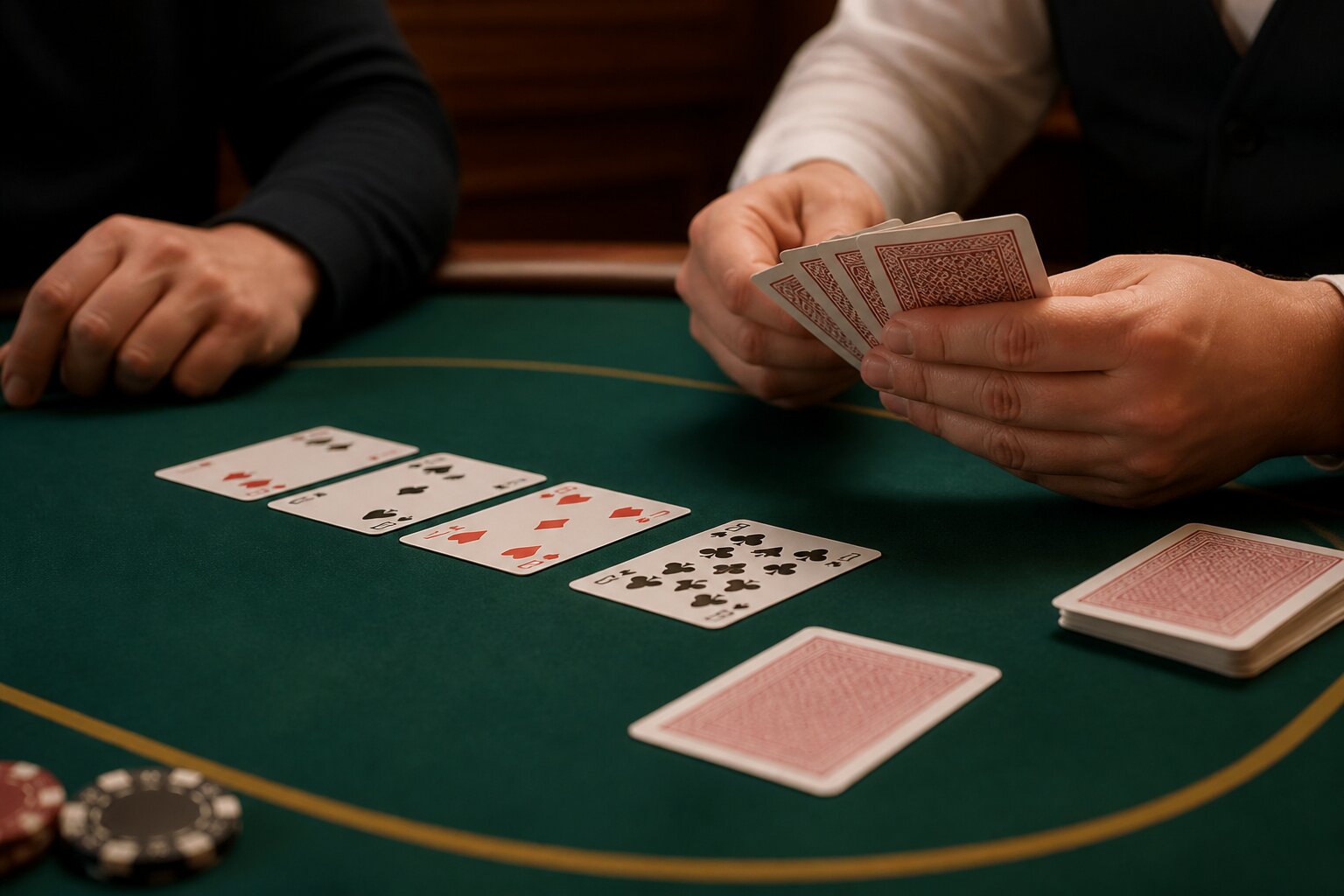
Fancy trying your hand at Pontoon but not sure where to start? You’re in the right place. Pontoon is a classic card game played in homes and casinos, known for its brisk pace and tactical choices.
Whether you’ve played a few hands before or you’re new to the table, getting to grips with the rules is the first step to enjoying the game. Read on to learn how the game works, the key terms you’ll meet, and the scenarios that decide who wins.
Ready to discover what makes Pontoon such a favourite? Let’s dive in.
What Is Pontoon and How Does It Differ from Other Card Games?
Pontoon belongs to the same family as Blackjack and is descended from the older game of Twenty-One. The objective is the familiar one: reach a hand total as close to 21 as possible without exceeding it. Despite that similarity, Pontoon has a handful of features that change the way rounds play out.
One difference is that both of the dealer’s cards are dealt face down, which keeps more information hidden until the end of the round. Terminology also changes: players “twist” for another card rather than “hit”, and they “stick” instead of “stand”. Pontoon also allows a “buy” — placing an extra stake to receive a further card faced down — and offers the Five Card Trick as a special winning combination. These rules shift the emphasis from simply matching 21 to managing risk, bet size and information.
Next, we’ll look precisely at what counts as a winning hand and how the different hand types rank against each other.
The Objective of Pontoon
The central aim is to reach 21 or as near as possible without going over, and to beat the dealer’s hand rather than other players. The strongest possible result is a Pontoon, which is an Ace combined with any 10-point card (10, Jack, Queen, King). A Pontoon beats all other hands.
Other notable winning hands include a total of 21 made with three or more cards, and the Five Card Trick — any five cards totalling 21 or less. A hand that exceeds 21 is a bust and loses immediately. For clarity: a hand of Ace plus Jack is a Pontoon and wins; a five-card collection such as 2, 3, 4, 5 and 6 totalling 20 is a Five Card Trick and will win unless the dealer has a Pontoon.
With the goals clear, the next section explains how many people can play and how the table is usually arranged.
How Many Players Can Take Part in Pontoon?
Pontoon is flexible in player numbers. At its simplest it needs two people: one dealer and one player, but it commonly accommodates several players at once. In friendly home games you’ll often see four or five players taking turns against the dealer; in gaming venues the limit is usually set by the number of seats at the table.
Players take turns individually against the dealer, so having more participants doesn’t change the core interaction—each player’s result depends on how their hand compares with the dealer’s. In casual settings the dealer role may rotate so everyone has a chance to deal, while in formal play the dealer typically remains fixed. With that settled, understanding card values will make the choices you face at the table much clearer.
Understanding Card Values and Hand Rankings
Card values in Pontoon are straightforward and determine how close you get to 21. Number cards carry their face value, so a 7 is worth seven points. Face cards — Jack, Queen and King — are worth 10 points each. The Ace is flexible and may count as 1 or 11, whichever suits the hand without putting it over 21.
Hand strength follows a clear hierarchy:
Pontoon: An Ace plus any 10-point card is the top-ranking hand.
Five Card Trick: Any five cards totalling 21 or less.
Ordinary hands: Any two, three or four card total of 21 or less that is not a Pontoon or Five Card Trick.
If a hand goes over 21 it busts and loses immediately. With values and rankings understood, the dealing procedure explains how those cards are brought into play and why suspense can build during a round.
How Are Pontoon Hands Dealt?
Dealing sets the tone for a round because most cards start face down, creating hidden information for players to work with. At the start, each player and the dealer receive two cards, all dealt face down so players keep their own hands private. That secrecy is part of the game’s strategy: choices are made with limited information.
When players choose to twist they receive extra cards one at a time, drawn in turn. The dealer manages the deck and oversees the sequence of play; once all players have finished taking twists or made their final choices, the dealer reveals their hand and settles outcomes according to the house rules. The dealer typically follows fixed drawing rules—for example, drawing on totals below a specified threshold—and their actions determine the final comparisons.
With cards dealt and the dealer’s role clear, the next section explains the range of actions available to players during their turns.
Player Actions in Pontoon Explained
During a turn, players choose among a set of standard actions that shape their hand and their stake. Understanding what each option does helps with tactical decisions as the round progresses.
Twist means taking another card in the hope of improving the total. Stick is the decision to take no more cards and leave the hand as it stands. Buy lets a player place an extra stake to receive one additional card face down; this is an alternative to the free twist and is often used when a hand looks promising but needs one more card to reach a strong total. Split applies when the initial two cards are the same value; splitting turns them into two separate hands, each played with its own stake.
Players keep their cards hidden while actively choosing twists or buys. A hand is revealed only once it is finalised—because the player has stuck, busted, achieved a Pontoon, or completed a Five Card Trick—and then the dealer compares it with their own hand to decide the outcome. The following section explains how those outcomes translate into payouts.
Pontoon Payouts and Winning Scenarios
Payouts reflect the relative strength of hands and are usually tied to the original stake. Common payout structures are as follows:
Pontoon (Ace + ten-point card) typically pays 2 to 1.
Five Card Trick also commonly pays 2 to 1.
An ordinary winning hand that beats the dealer pays 1 to 1.
A push, where the player and dealer have the same total, returns the stake.
A losing hand, whether by busting or having a lower total than the dealer, results in the loss of the stake.
House rules can vary, so it’s sensible to check the precise paytable where you are playing. With reward levels clear, good table manners keeps play pleasant for everyone involved.
Essential Pontoon Table Etiquette
Polite behaviour helps a game flow and ensures everyone has a fair experience. Wait until it’s your turn before taking any actions, and handle only your own cards unless the rules say otherwise. Keep cards visible when required and place bets clearly when prompted by the dealer. Avoid distracting other players while they are making decisions and address the dealer and fellow players with courtesy, whatever the result.
These practices also support safe and fair play at the table. Enjoy the game, take sensible precautions with your stakes, and let the round move at a comfortable pace for everyone.
You now have a full overview of how Pontoon plays, what hands beat others, and how to behave at the table—everything needed to join a game and follow the action confidently.
Explore Casino Games at Cash Casino
We believe there’s something enjoyable about taking time out to unwind and explore what our site has to offer. Whether you’re new to online casinos or have played before, our welcoming community is here for you.
Getting started couldn’t be easier – just create an account, make a deposit and you’re all set. We look forward to seeing you at the tables and wish you a great time with us.
**The information provided in this blog is intended for educational purposes and should not be construed as betting advice or a guarantee of success. Always gamble responsibly.