Blackjack has plenty of phrases that can sound odd at first. One that often catches the ear is “monkey”, which seems out of place until you hear how players use it.
Learning what it means makes table chat easier to follow and helps new players feel more at home around the game.
This blog post explains the meaning, where the term came from, how it’s used in conversation, a few regional twists, and simple etiquette to keep things friendly. If you choose to play, keep it within your means.
What Does Monkey Mean In Blackjack?
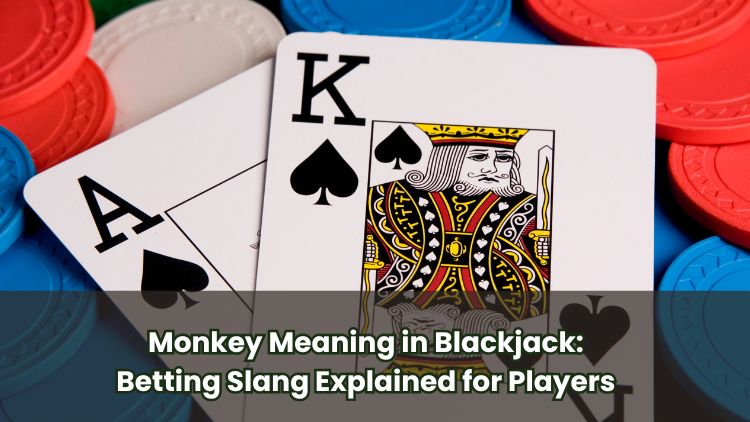
In blackjack, “monkey” is slang for any card worth ten points. That includes the 10, Jack, Queen and King, all of which count as ten in standard play.
You’ll hear it when someone wants the next card to be a ten-value. A player might say “monkey” after doubling on 11 or when a ten would strengthen their total.
It’s table talk, nothing more, and simply expresses the card a player would like to see. So, where did the word come from in the first place?
Where Did The Term 'Monkey' Come From?
The exact origin is uncertain, but there are a few credible threads. Many suggest it took hold in parts of Asia, where English card slang sometimes labelled face cards as “monkeys”. As the phrase travelled with players and dealers, it found a home at blackjack tables in the UK, the United States and beyond.
There is also long-standing betting slang where a “monkey” can mean five hundred, but in blackjack the meaning shifted to ten-value cards through repeated use in casual table chat rather than formal rules.
With the backstory in mind, it helps to see how players actually use it while placing their bets and waiting on the next card.
How Is 'Monkey' Used When Placing Bets?
“Monkey” is not about stake size. It is almost always said after chips are down, while players are waiting for a card that could help their hand.
If a player needs a ten to improve their position, they may quietly say “monkey” as the dealer prepares to draw. Others might echo it in a light-hearted way. It is part of the social sound of the table, not a signal with any procedural impact.
That sets up how it sounds in real conversation during a hand.
Examples Of 'Monkey' In Table Conversation
You might hear a player dealt an 11 lean forward with a grin and say “monkey” before their hit or double is resolved. Another common moment is when a player has a soft 18 against a strong dealer card and wants a ten to firm up the total.
Spectators sometimes join in too, offering a soft “monkey” for a friend’s key draw. At lively tables, more than one person might say it when several hands are in play and a ten-value could shift the round.
It is an informal nudge about preference. Saying it does not influence which card arrives, and dealers will proceed exactly as the rules require. If you play in different places, you may hear other phrases serving the same purpose.
Equivalent Betting Slang And Regional Variations
Slang varies by region and by table. Some players simply ask for a “ten”. Others use “paint” when they want a face card, which covers Jack, Queen and King but not the 10. In the UK, “face card” is a straightforward term for picture cards, and in some Asian rooms “monkey” tends to be linked to those same faces.
Because slang is informal, usage shifts with the crowd and the venue. If a term is unfamiliar, a quick listen is usually enough to pick up what people mean.
Knowing the language around the table also sheds light on how dealers and players tend to react when they hear it.
Does Saying 'Monkey' Affect How Dealers Or Players React?
Most dealers recognise “monkey” as harmless chat and keep things professional. They will deal the game as normal and remain neutral. Experienced players often take it in good humour, and some may join in, depending on the table’s mood.
Reactions depend on the atmosphere. Quiet tables may keep comments to a minimum, while more social tables allow a bit of chatter. Polite, concise remarks are usually fine; anything that disrupts the flow or pressures others is not.
Still, a few myths and mix-ups do crop up around the term.
Common Misunderstandings About 'Monkey'
A frequent misconception is that “monkey” refers only to face cards. In blackjack it covers all ten-value cards, including the 10 itself as well as the Jack, Queen and King.
Another misunderstanding is that saying “monkey” can change what happens next. It cannot. The dealing procedure is fixed, and words at the table do not alter the order of cards.
Some newcomers assume it is an official term used by dealers. It is not. “Monkey” is informal slang used by players in conversation.
Table Etiquette For Using Betting Slang
Using slang like “monkey” is usually fine when it fits the table’s tone. Good manners still matter. Keep comments brief and respectful, and be mindful that not everyone will know the phrase. Clear language helps the whole table follow the action.
It helps to read the room. Some tables are chatty, others prefer quiet focus. If in doubt, keep it low-key. Never use slang in a way that pressures the dealer or other players, and avoid remarks that could distract someone mid-hand.
If you choose to play, set personal limits that suit your circumstances and stick to them. Take breaks, and keep betting occasional. If gambling starts to affect your well-being or finances, seek support early. Independent organisations such as GamCare and GambleAware provide free, confidential help.
Understanding “monkey” is a small but useful piece of blackjack vocabulary, and knowing when and how to use it keeps the game friendly, clear and enjoyable.
**The information provided in this blog is intended for educational purposes and should not be construed as betting advice or a guarantee of success. Always gamble responsibly.