
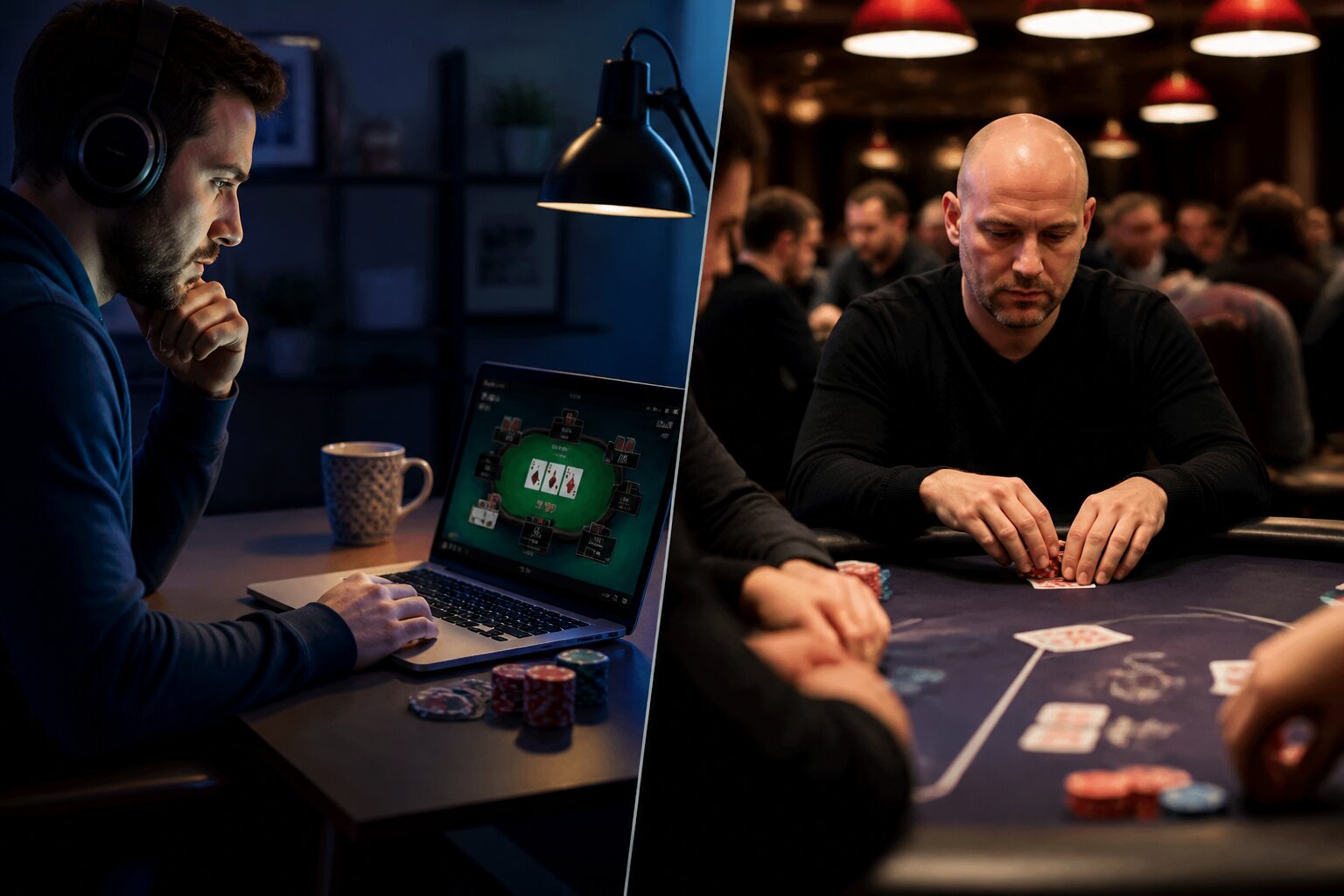
Ever wondered whether online poker is tougher than playing in person? It’s a common question, and the short answer is: they test slightly different skills. Both formats follow the same basic rules, but the way the game feels and the decisions you make can vary a lot.
This article walks through the main contrasts — pace, reading opponents, behaviour and the practical things that matter when you’re choosing where to play. Each section explains the point clearly and gives examples so you can decide which style suits you best.
Read on and you’ll get a fair sense of what to expect from each version, and which one might fit your game and schedule.
What Are the Core Differences Between Online and Live Poker?
Online and live poker share the same hand rankings and basic mechanics, but they differ in how the game unfolds and how you interact with other players. The differences are practical as well as psychological, and they influence the skills you need to succeed in each format.
Gameplay
The biggest single difference is speed. Online tables deal many more hands per hour because there is no physical shuffling, no dealer button passing, and action is usually faster. That higher tempo changes the rhythm of decision-making and how you structure your time at the table.
Online play rewards quicker reads, efficient bankroll management and a disciplined approach to variance. Live play gives more time to think and adjust between hands, which can help with deeper reads and emotional control. The faster pace online also makes multi-tabling possible, which can increase volume but requires strong focus and task-switching skills.
Setting
Live poker places you in a physical environment — a poker room, club or casino — where the surroundings, noise and table dynamic are part of the experience. Those conditions can affect concentration, stress levels and how you present yourself at the table.
Online, you sit at your device, often playing in private and sometimes across multiple tables. Playing from home or a cafe changes the social element and can make it easier to use tools or take notes without drawing attention. The environment you choose influences comfort, stamina and how long you can play effectively.
Common elements of the live setting include:
- table chatter and ambient noise
- proximity to other players and staff
- visual details like chips and body language
Interaction
Face-to-face tables allow observation of facial expressions, posture and other physical cues. Small details that may be useful include:
- facial expressions and micro-expressions
- posture and how a player handles chips or cards
- timing of bets and visible body language
Online, you lose most of those visual cues and rely on the sequence of bets, timing patterns and statistical trackers if they are available. That forces a shift from visual reading to pattern recognition, situational analysis and attention to betting lines.
Each of these factors affects the decisions you make and the skills you rely on, so it helps to be clear which elements matter most to you before switching formats. Consider where you perform best, how much time you want to commit and which format matches your temperament and goals.
Does Player Behaviour Change Online Versus Live?
Players tend to act differently depending on the setting, and recognising those tendencies helps you adapt.
Online Play
Online players often make faster decisions and play many more hands than in live games. Anonymity can lead to bolder or more experimental plays, and some players split their attention across multiple tables, which lowers the overall level of visible information and changes the standard of play you’ll face.
You will also encounter a wider range of stakes and formats available at almost any time, from short fast-fold games to deep-stack tournaments. This variety rewards flexible strategies, disciplined bankroll control and careful observation of patterns rather than single actions.
Live Play
In person, the social element slows things down. People take longer to act, conversations happen at the table, and players may adopt more conservative approaches simply because they can be observed.
The structure of a live session also affects how people approach risk and patience. Examples include:
- travel to and from the venue,
- scheduled breaks and pacing of play,
- table etiquette and face-to-face interaction.
Those factors can increase fatigue or tilt, and they make timing, table talk and physical tells more relevant to your decisions.
Strategy Shifts
Because behaviour differs, your approach must adapt. Online, you focus more on frequency, ranges and exploiting tendency-based patterns that emerge over many hands.
Live, you place greater weight on timing, posture and isolated reads gathered in single sessions. Both settings reward awareness: paying attention to how opponents behave, staying disciplined and managing your session responsibly gives you an edge while helping reduce risk.
How Do Speed and Volume Affect Difficulty?
The pace of play shapes the mental demands of poker.
Online poker’s higher hand volume means you see more situations in less time. That speeds up learning curves, since you experience many scenarios quickly, but it also increases mental load. Constant decision-making requires good focus, solid routines, and sensible limits to avoid fatigue.
Live play’s slower tempo gives more breathing room. You can reflect on prior hands between deals, discuss plays with friends, and gradually settle into a session. That environment suits players who benefit from time to deliberate and extract reads from the table dynamic.
Either format can feel harder depending on whether you prefer to process information quickly or in a more measured way. The key is structuring sessions and breaks so you stay sharp regardless of volume.
Are Reading Opponents and Tells More Challenging Online?
Reading opponents is simply different rather than harder.
In a live setting, visual tells can offer useful clues. A single gesture or change in posture might inform a decision, but those signals can be noisy and misleading if taken alone. Online, physical tells disappear and you must infer info from bet sizes, timing patterns, and how a player adjusts across hands. That often requires consulting hand histories and looking for consistent tendencies.
Both approaches demand interpretation and context. Good players combine multiple pieces of information — action history, table composition and game flow — rather than relying on one signal. Mastering either style takes practice, and converting experience from one format to the other is a gradual process.
Why Do Some Players Find Transitioning Harder Than Others?
People adapt at different rates because they bring varied strengths and habits to the table.
Some players flourish in social environments and use conversation and physical reads as part of their toolkit; stepping online removes that resource and feels uncomfortable. Others thrive on quick decision-making and the efficiency of online play; live poker’s slower pace can interrupt their rhythm. Technical familiarity matters too: navigating software, multiple tables or unfamiliar betting interfaces can be a barrier for some.
Personality, prior experience and how someone processes information all influence how easily they switch. Accepting that adaptation takes time and focusing on one or two transferable skills — hand selection, pot control, and position play — smooths the process.
Common Myths About Online Poker Difficulty
There are several persistent misconceptions about how fair or hard online poker is.
One myth is that online games are inherently unfair. Reputable operators use audited random number processes and monitored systems to ensure outcomes are fair and transparent. Another is that every online player uses advanced software to gain an automatic advantage. While tools exist that help analyse play, they do not replace skill and practice; many successful players rely on experience and thoughtful adjustments rather than on software alone.
Finally, the idea that one format is categorically easier than the other ignores the different demands each places on the player. Recognising the real differences — speed, interaction and information sources — helps separate myth from fact and focus on improving where it matters.
Which Format Is Better for Beginners?
Beginners benefit from matching the learning environment to their needs.
Live poker offers time and social support that can aid learning: slower play allows for observation and discussion, and dealers or more experienced players can sometimes offer informal guidance. Online poker offers convenience, lower or freer stakes and the ability to focus on specific aspects of the game quickly through high hand volume.
Either path is valid. A practical approach is to try both in low-pressure settings and see which helps you learn more effectively. Keep sessions short, track how you feel during and after play, and adjust where you practise accordingly.
Choosing the Right Poker Environment for You
Finding the right environment comes down to personal fit and how you prefer to develop as a player.
Think about what you enjoy and how you handle intensity. If you prefer measured decision-making and social cues, live play may suit you. If you value convenience and rapid experience, online tables offer efficient practice. Be realistic about time and financial limits, and adopt simple safeguards like session duration and pre-set spending thresholds to keep play controlled.
Choosing where to play is not a final judgement on your ability — it’s a strategic decision about where you will learn best and have the most consistent experience. Try different formats, reflect on what improves your game, and settle on the environment that supports steady progress and enjoyment.
**The information provided in this blog is intended for educational purposes and should not be construed as betting advice or a guarantee of success. Always gamble responsibly.