
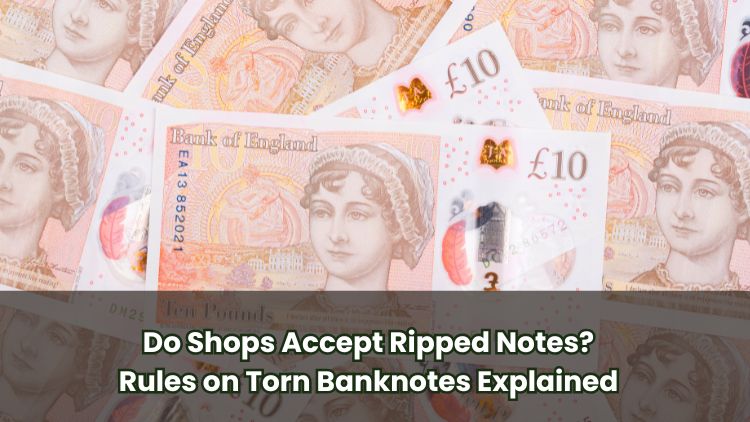
Most people will come across a torn or worn banknote at some point. It is not always clear whether a shop will take it or if it is still classed as legal tender.
This guide sets out how retailers decide whether to accept ripped notes, what counts as too damaged, and how much of a note needs to be intact. It also looks at quick fixes, such as tape, and when they help or hinder.
If you want to replace a damaged note, you will find what banks usually ask for, how the Bank of England deals with badly damaged notes, and practical alternatives if a shop refuses your cash, so read on for clear answers.
Will My Local Shop Accept A Torn Banknote?
Some shops may accept a torn banknote, but it is not guaranteed and the final call usually sits with the person on the till.
If the damage is minor, such as a small tear or a missing corner, many retailers will still take it. Notes with larger missing sections, unreadable serial numbers, or obscured security features are more likely to be declined. Staff are trained to spot counterfeits and may be cautious if damage makes checks difficult.
Retailers also think about whether they can bank the note without trouble. If a cashier believes a bank might reject it, they may decide not to accept it in the first place.
If your note is refused, try another retailer or take it to a bank to ask about a replacement or a deposit. Wondering whether a torn note is still legal tender? That is the next piece of the puzzle.
Are Torn Banknotes Still Legal Tender?
A genuine banknote can remain legal tender even if it is damaged. Legal tender means it can be used to settle a debt in law, but it does not force a shop to accept it at the till. Retailers can refuse any note they feel is too damaged to verify.
The Bank of England offers guidance and a replacement service for damaged notes. So while a shop might say no, there is usually a route to redeem the value if the note can be confirmed as genuine.
With that in mind, the practical question is how much of the note needs to be there before anyone will consider taking or exchanging it.
How Much Of A Banknote Must Be Intact For It To Be Accepted?
In everyday use, retailers look for most of the note to be present and readable. Small tears or a clipped corner are often fine, but a note that is missing a large section, split through key features, or heavily marked may be declined on sight.
For exchanges, the Bank of England generally expects at least half of the original note to be intact and identifiable. It helps if the value, serial number, and key security features can be checked. If the note is in pieces, keeping all fragments together strengthens the case.
Shops use their judgement, so decisions vary. If a cashier hesitates, the same note might be accepted by your bank or processed through the Bank of England’s damaged notes service.
How Do Retailers Decide To Accept Or Refuse Torn Notes?
Most retailers follow internal policies and basic checks. Staff look for security features on polymer notes, such as the see-through window, foil patches, raised print, and clear serial numbers. If these features can be examined without confusion, the note stands a better chance of being accepted.
If a large area is missing or vital details are obscured, the note may be refused because it cannot be verified. Shops also consider practicalities, like whether their own bank will accept the note when they deposit the day’s takings. Some businesses prefer to avoid the risk of a dispute at the counter.
If a note is borderline, a bank visit is often the simplest way to settle the question. That brings up a common fix people try at home.
Can I Use Tape Or Sticky Fixes To Mend A Torn Banknote?
Clear tape can hold a torn note together, but it does not guarantee acceptance. Tape can cover security features, create glare that makes checks harder, or leave residue that raises doubts about tampering.
Some retailers will still accept a neatly repaired note if everything remains visible. Others will not, especially if tape crosses the clear window, foil areas, or serial numbers. Banks may be more flexible, since they can send notes for verification, but it depends on branch policy and the condition of the note.
If you plan to exchange a repaired note, avoid covering key features and keep all parts together so staff can see the full picture.
How To Replace A Damaged Banknote At A Bank
Banks and building societies can often help with damaged notes, especially for their own customers. They will assess the note, check it is genuine and complete enough, then either exchange it there and then or arrange for it to be processed. Larger branches tend to offer this more reliably.
You may be asked for identification or account details so that any payment can be made directly into your account. If a branch cannot handle the exchange on the spot, they may point you to the Bank of England’s damaged notes process. Turnaround can take a little time, since each case is checked carefully.
What Pieces Of A Note Do Banks Require?
Banks usually want at least half of the note, and ideally all remaining pieces, so they can confirm the denomination, serial numbers, and security features. If the note is in fragments, bring everything you have and keep the pieces together without covering critical details.
For severely damaged notes, the Bank of England provides a specific application process. You may be asked to explain how the damage happened, and in some cases to provide proof of identity. If the note is contaminated by soil, mould, or other substances, ask the branch how best to handle it before bringing it in.
Alternatives If A Shop Refuses A Torn Banknote
If a retailer says no, a bank or building society is often the next stop. Many will exchange or accept a deposit if the note is genuine and sufficient parts are present. Some Post Offices help with exchanges, although this depends on local policy.
If none of these options work, the Bank of England’s damaged banknote service can assess the note and pay the value if it meets their criteria. It is also worth considering a digital payment in the moment and dealing with the damaged note afterwards, which avoids a hold-up at the checkout.
If your cash use relates to gambling, keep to your own limits and use safer gambling tools where available.
What To Do With Severely Burnt Or Water‑Damaged Notes?
Retailers are unlikely to accept notes that are badly burnt, soaked, or otherwise degraded, because the security features and value can be hard to confirm. In these cases, the Bank of England’s damaged notes service is the usual route.
Keep any fragments you can, avoid cleaning or separating delicate pieces further, and contact your bank or check the Bank of England’s guidance on submitting a claim. You may be asked for details about the damage and, in some instances, identification so payment can be made to you directly. Processing times vary, since each claim is reviewed on its own facts.
Between your bank, the Post Office, and the Bank of England, there is almost always a way to resolve damaged cash. Knowing these options means a torn or stained note does not have to go to waste.
**The information provided in this blog is intended for educational purposes and should not be construed as betting advice or a guarantee of success. Always gamble responsibly.